


While the internal codenames athens and songyuan have been known for months, a fresh wave of leaks from supply chain insiders has finally pulled back the curtain on the raw hardware powering the REDMI K100 series. Xiaomi is not just planning an iterative update; they are preparing a generational leap in performance and endurance that could redefine the “Ultra” segment under the POCO F9 Ultra global branding.
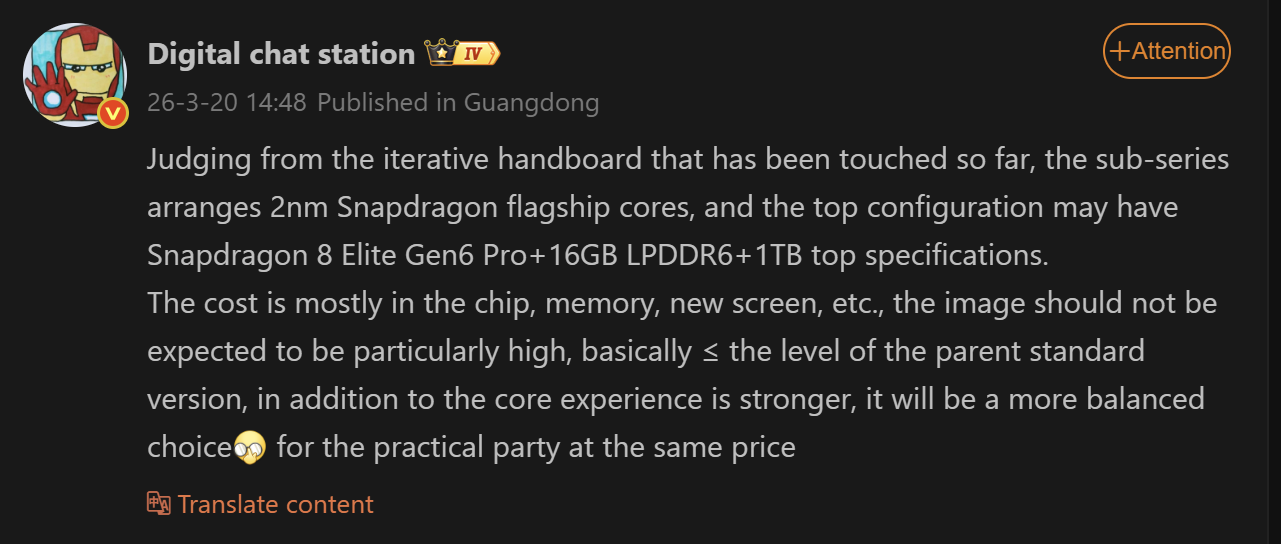

The 2nm Frontier: Snapdragon 8 Elite Gen 6 Pro and LPDDR6
The headline of this March leak is the official testing of the Snapdragon 8 Elite Gen 6 Pro. Built on TSMC’s 2nm process, this chip is designed to tackle the next frontier of on-device AI and “Hyper-Tasking.”
-
Next-Gen RAM: The Q11X (REDMI K100 Pro Max) is confirmed to be testing with 16GB/24GB LPDDR6 memory. This is a critical shift, as LPDDR6 provides the necessary bandwidth to keep up with the 2nm SoC’s throughput.
-
Imaging Overhaul: For the first time, a REDMI device is tipped to feature a 200MP main camera (1/1.28-inch sensor) paired with a 50MP periscope telephoto lens. This move suggests Xiaomi is closing the gap between the REDMI K series and the premium Xiaomi numbering series.
-
The Battery Breakthrough: The most shocking detail is the battery capacity. Prototypes are currently running a massive 8,500mAh silicon-carbon battery. Despite the capacity, the device reportedly maintains a profile under 8.5mm, utilizing next-gen density tech.
Devices & Global Rebranding
The leak confirms two primary models for the initial rollout:
-
REDMI K100 (Q11 / athens): Equipped with the Snapdragon 8 Elite Gen 5. It will launch globally as the POCO F9 Pro Max.
-
REDMI K100 Pro Max (Q11X / songyuan): The 2nm flagship equipped with the Snapdragon 8 Elite Gen 6 Pro. It will launch globally as the POCO F9 Ultra.
-
Software: Both units are currently running early builds of Xiaomi HyperOS 3, optimized for the 2nm architecture.
Market Impact: The “Chip Crisis” Price Hike
Innovation at this level isn’t cheap. Due to the high production costs of 2nm wafers and the global shortage of high-density battery components, the REDMI K100 Pro Max is expected to see a price increase of approximately $150 over its predecessor. Xiaomi is officially confirmed this.
Launched initially in China, the top-tier 1TB variant is expected to retail for around $825 (~5,700 CNY). While this pushes the K-series into a new price bracket, the hardware specs—specifically the 200MP periscope and the 8,500mAh cell—position it as a “flagship killer” in every sense of the word.
Xiaomi’s Strategy: Dominance Through Hardware
Xiaomi’s 2026 strategy with the K100 series is clear: provide hardware specs that make the competition look outdated. By being the first to market with 2nm tech and 24GB LPDDR6, Xiaomi is catering to the “power-user” demographic.



