
 Emir Bardakçı
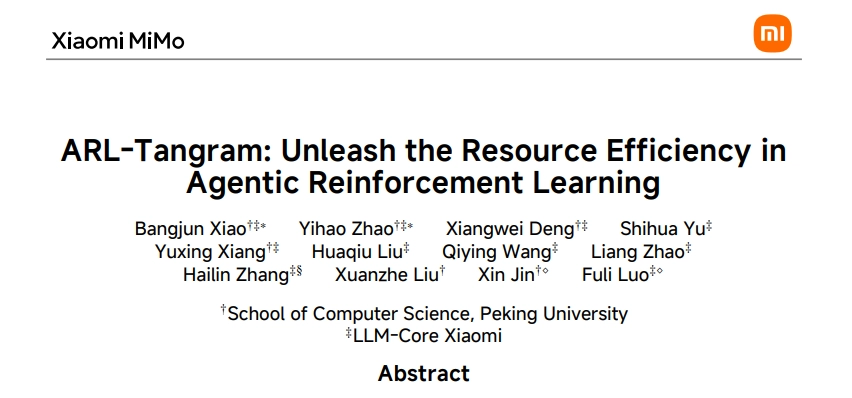
In a major move for the global AI landscape, the Xiaomi AI team, led by former DeepSeek researcher Luo Fuli, has announced a breakthrough in artificial intelligence efficiency. Through a joint research paper with Peking University, Xiaomi introduced ARL-Tangram, a system designed to optimize the performance of AI Agents while drastically cutting hardware and energy expenses.
Technical Breakdown: How ARL-Tangram Works
The core of this innovation lies in how the system manages computing resources. Typically, AI “Agents”—the software responsible for making proactive decisions in a system—require massive amounts of processing power. ARL-Tangram optimizes this by implementing a “unified action-level formula” and an “elastic scheduling algorithm.”
-
Resource Management: The system intelligently allocates tasks to different hardware parts based on their current load and constraints.
-
Speed Improvements: Technical tests show that this system improves the average Action Completion Time (ACT) by 4.3 points and speeds up AI training steps by up to 1.5 times.
-
Massive Savings: Most importantly, the technology reduces external computing resource requirements by 71.2%.
Market Impact and Xiaomi’s Strategy
By slashing computing costs by over 70%, Xiaomi is positioning itself to offer advanced AGI (Artificial General Intelligence) features without the heavy price tags associated with cloud-based AI. This allows the company to remain competitive in its global pricing ($) while providing high-end software capabilities.
This marks a significant step for Xiaomi as it transitions from a hardware manufacturer to an AI-first technology leader. The integration of ARL-Tangram into the Xiaomi MiMo large model ensures that the “Human x Car x Home” ecosystem remains the most optimized in the industry.