


Xiaomi has moved past just being a smartphone manufacturer, as they have entered the automotive sector as a force to be reckoned with as well. The massive success that came with the Xiaomi SU7 crossover, as well as the new Xiaomi YU7 crossover, has already led them to look toward their next evolution, which would be range-extended electric vehicles, or EREVs.
This came from Pan Jiutang, a partner at Xiaomi’s Industrial Investment Department, and it sparked an interesting discussion regarding the future product line of this brand. I have been keeping tabs on how quickly Xiaomi has grown in the EV market, and it appears that this company is now set to make a transition into a new technology that it had previously chosen not to participate in—and it is taking cues from its competition.
TL;DR
- Xiaomi is openly considering developing range-extender (EREV) models to follow the Xiaomi SU7 and Xiaomi YU7.
- Executive Pan Jiutang confirmed Xiaomi would “learn from Li Auto” but will maintain its own brand integrity.
- New reports suggest two EREV SUVs (codenamed Kunlun) could arrive by late 2026.
- Redmi K series logic applies here: while currently China-exclusive, these automotive innovations often set the stage for future global tech exports.
Will Xiaomi Launch a Range Extender?
The short answer is: it’s looking more likely than ever. Pan Jiutang spoke about the change in the industry, saying, “Most of the other Chinese automakers failed by simply imitating Tesla, but what Xiaomi did was take its own unique route with the Xiaomi SU7.” He went on to say, though, that if Xiaomi chooses to enter the EREV market, “We will measure ourselves against the current leader, Li Auto.”
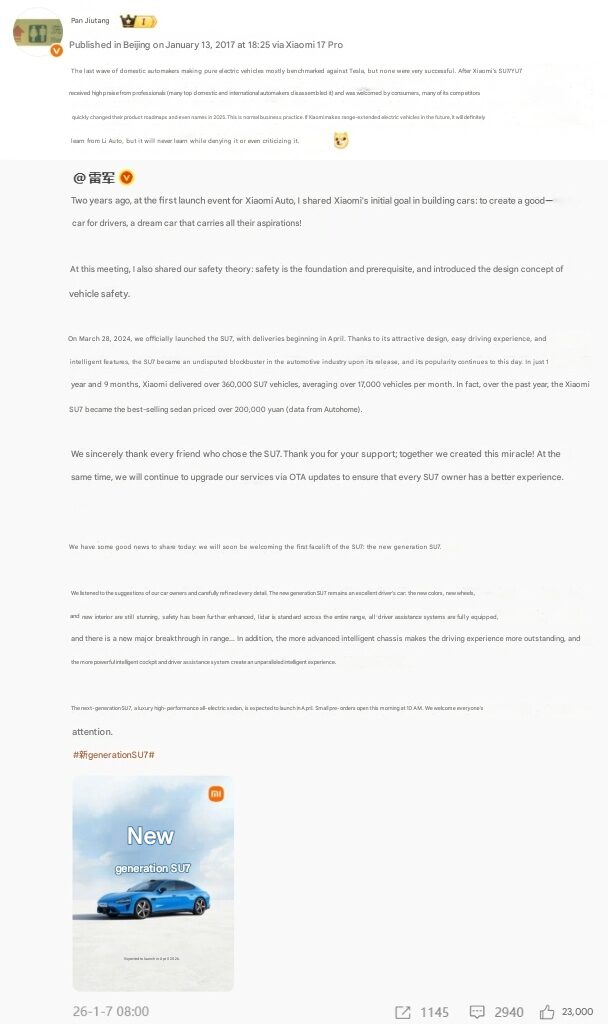
It is quite refreshing to see an executive being so upfront about this. We usually see the tech giants being very secretive about their benchmarking, but Xiaomi seems to be embracing the “imitation as learning” mentality. Pan did mention that even giants like Apple and Google have a history of copying successful tech to boost their ecosystems.
The Success of the Xiaomi YU7 and SU7
The Xiaomi SU7 may be considered a huge success, but the Xiaomi YU7, which marks the company’s foray into the crossover category and into the luxury market, has definitely established them as a force to be reckoned with. Several other brands are now struggling to take the YU7 apart and see how Xiaomi has managed to so deeply integrate the Xiaomi HyperOS into it.
In China, the Redmi K70 Ultra and Redmi K80 Ultra (commonly known as POCO or Xiaomi T Series elsewhere in the world) have already proven that they can integrate high-performance hardware. We can see that same “Ultra” spirit being translated to their cars as well, as they are being influenced by Snapdragon 8 Elite to shape the future of smart cockpits.
Note: Although the Xiaomi YU7 is at this time available only in the Chinese market (starting at around $35,500 USD), the technology behind the Xiaomi HyperConnect worldwide network is based on this product.
What’s Next for Xiaomi Auto?
As per the internal leaks and Pan’s statements, the “next wave” would be to go beyond battery electric vehicles. Come 2026, we would see a 7-seater flagship SUV with a range-extending engine. This would take care of the “range anxiety” that still worries many people, even with Xiaomi’s 800V fast charging system. We also anticipate that the new models will come with even tighter integration with Xiaomi HyperConnect, so that your Xiaomi Band 9 or XRING O1 will be able to synchronize data with the climate and seating systems in the car.



