 Emir Bardakçı
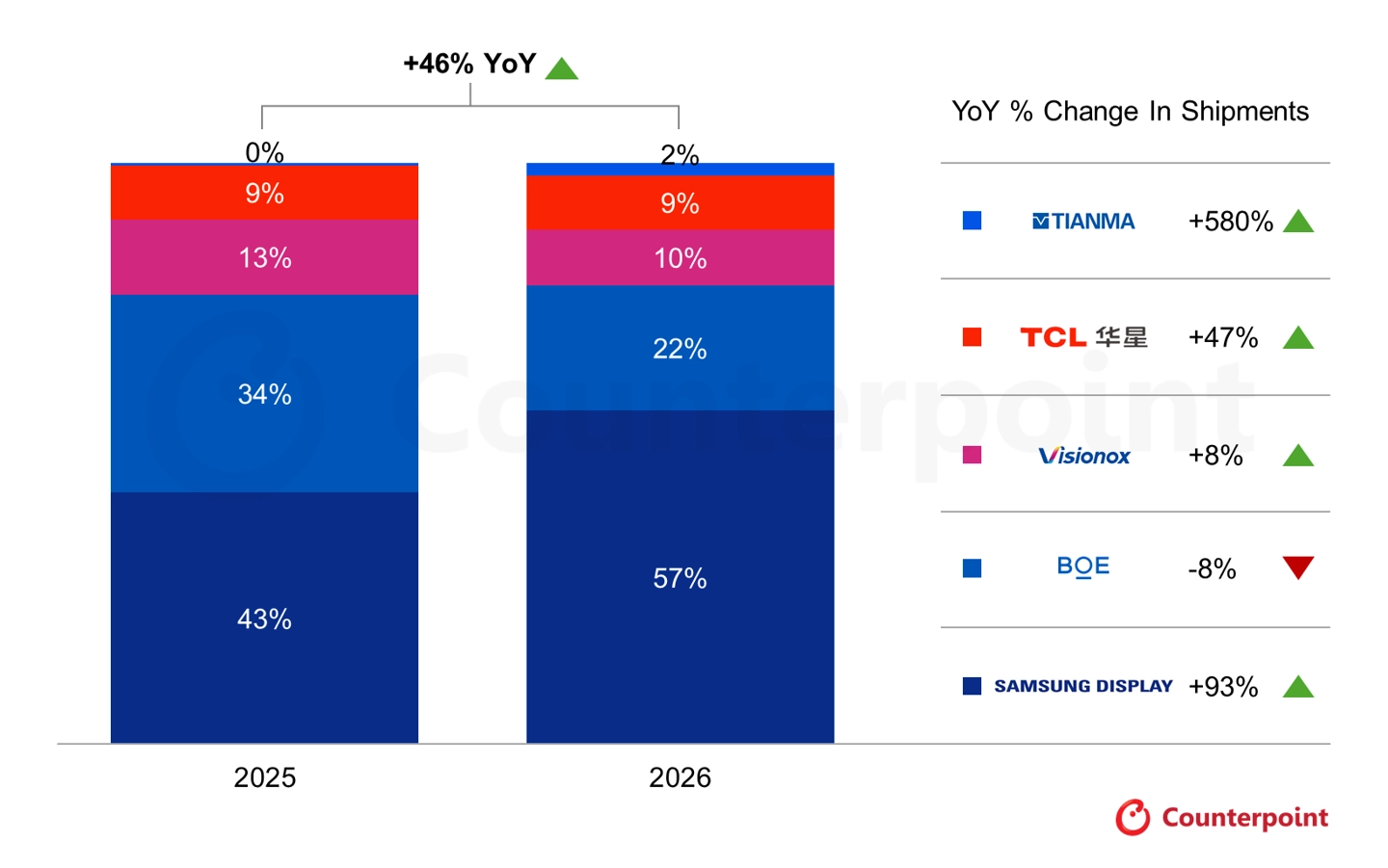
The global shipment of foldable smartphone panels will shoot up by 46% year-over-year in 2026, as suggested by a latest report from Counterpoint Research. The major reason for this upsurge will be the entry made by Apple in the foldable smartphone market. It will have a significantly influential role on global designs. As can be noticed in our reports on Xiaomi foldable innovations, Xiaomi device policies, and HyperOS, prominent brands are rushing ahead with their plans to catch up with these developments.
Apple’s Entry and Its Effect on the Foldable Industry
Apple will be set to start procuring panels for its first foldable iPhone as from 2026. It represents an exciting paradigm shift within the global foldable industry as Apple’s entry will be poised to drive demand, uniform designs, and user preference shifts towards larger and productivity-driven screen form factors.
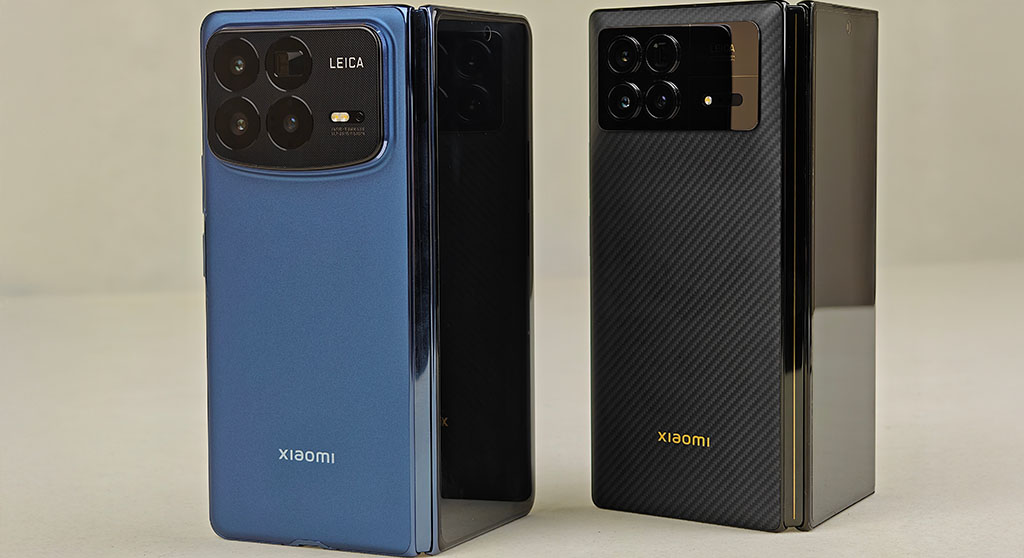
Industry analyst Guillaume Chansin emphasizes Apple’s impact will “revitalize the foldable panel supply chain” and stimulate suppliers to raise production and market expectations. From Xiaomi’s expertise with foldable panels, achieved via MIX Fold series, it’s clear dedicated panel R&D influences brand direction. Although Xiaomi MIX Fold 5 failed to make an appearance in 2025 as expected, Xiaomi still participated at MWC 2025 with Xiaomi MIX Flip 2, but it will be back with Xiaomi 17 Fold and Xiaomi 17 Flip.
Samsung Display Holds on to Leads
Samsung Display is forecast to obtain around 57% market share for foldable panels in 2026, with mature technology, efficiency, and a large supply chain. Samsung Display will be the main beneficiary of the emerging market created by Apple’s entry.
Other major suppliers will experience mixed fortunes:
- BOE: -8%
- Visionox: 8%
- TCL CSOT: 47%
- Tianma: 580
The growing popularity of larger foldable panels will also raise the Average Selling Price (ASP) for displays in the next year, boosting profitability for the industry.
Book-Style Foldables Emerge as the Preferred Form Factor
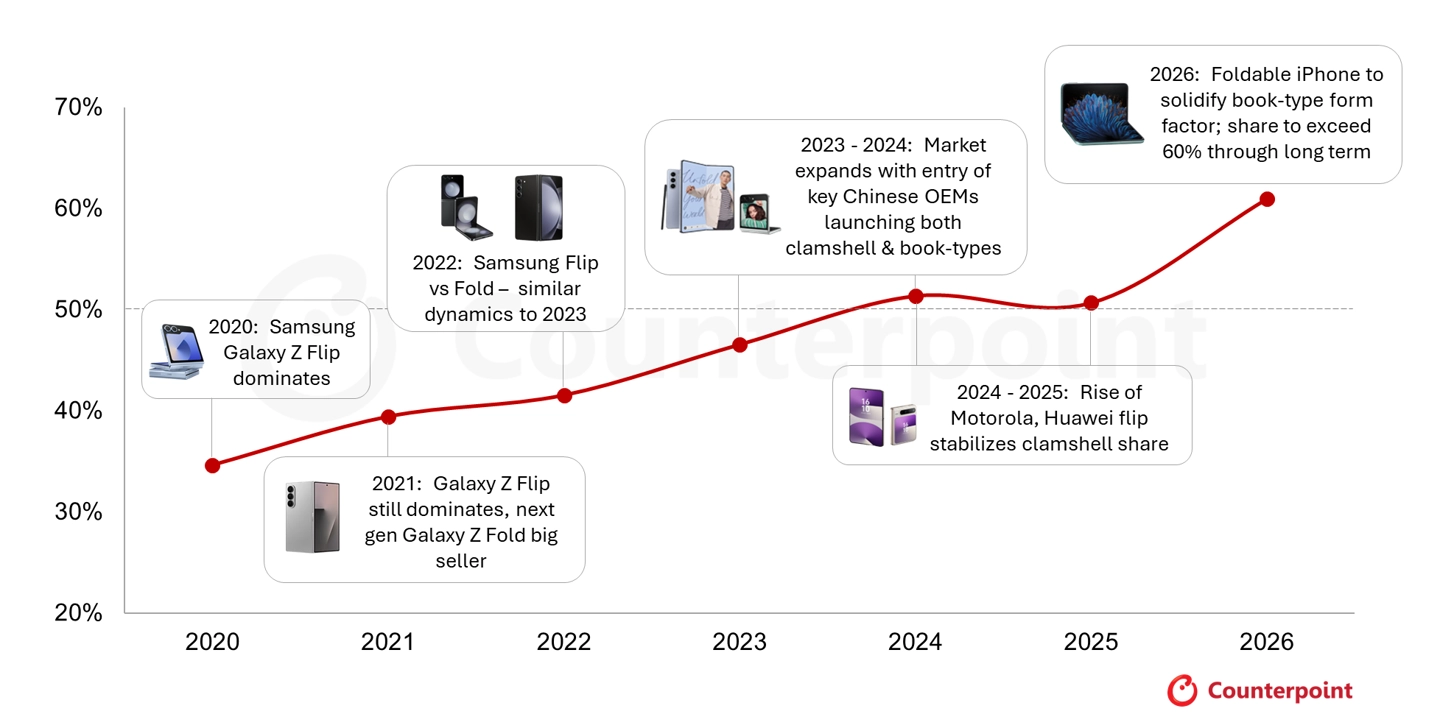
There have been major shifts in consumer preferences towards book-like foldables and larger internal screens. There have been several years of exploration with vertically foldable devices, and there has been a focus on devices with productivity capabilities on the level of a tablet.
A good example here would be the Samsung Galaxy Z Fold7 lineup. During the latter half of 2025, it became evident that for the first time, there were more sales of horizontally foldable models, like Fold, as compared to the vertically foldable models, like Flip.
Industry expert Liz Lee breaks down that while foldable phones cost more compared with traditional smartphones, they offer additional benefits that make it worthwhile for users.
Xiaomi Foldable Device Plans Could Be Affected
As Apple has entered the market for foldable devices and Samsung is also strengthening its lead, the market competition will intensify. Because Xiaomi has been working on panels for a long term and with its previous MIX Fold series, it will be well-equipped to counter.
Skipping MIX Fold 5 in 2025 while concentrating on the MIX Flip 2, a comeback strategy with Xiaomi 17 Fold and Xiaomi 17 Flip is being implemented. It will be seamlessly combining Xiaomi’s display engineering, hinge longevity, and Xiaomi HyperOS, which aims at completing productivity, advancements.
So, with an expanding market for foldable phones, it leads to a question of whether Apple can offer an equivalent level of folding experience that Xiaomi and some early starters have perfected with time.
Only time will show how Apple will disrupt the market andwhether Xiaomi again raises the bar with its return in 2026.