 Emir Bardakçı
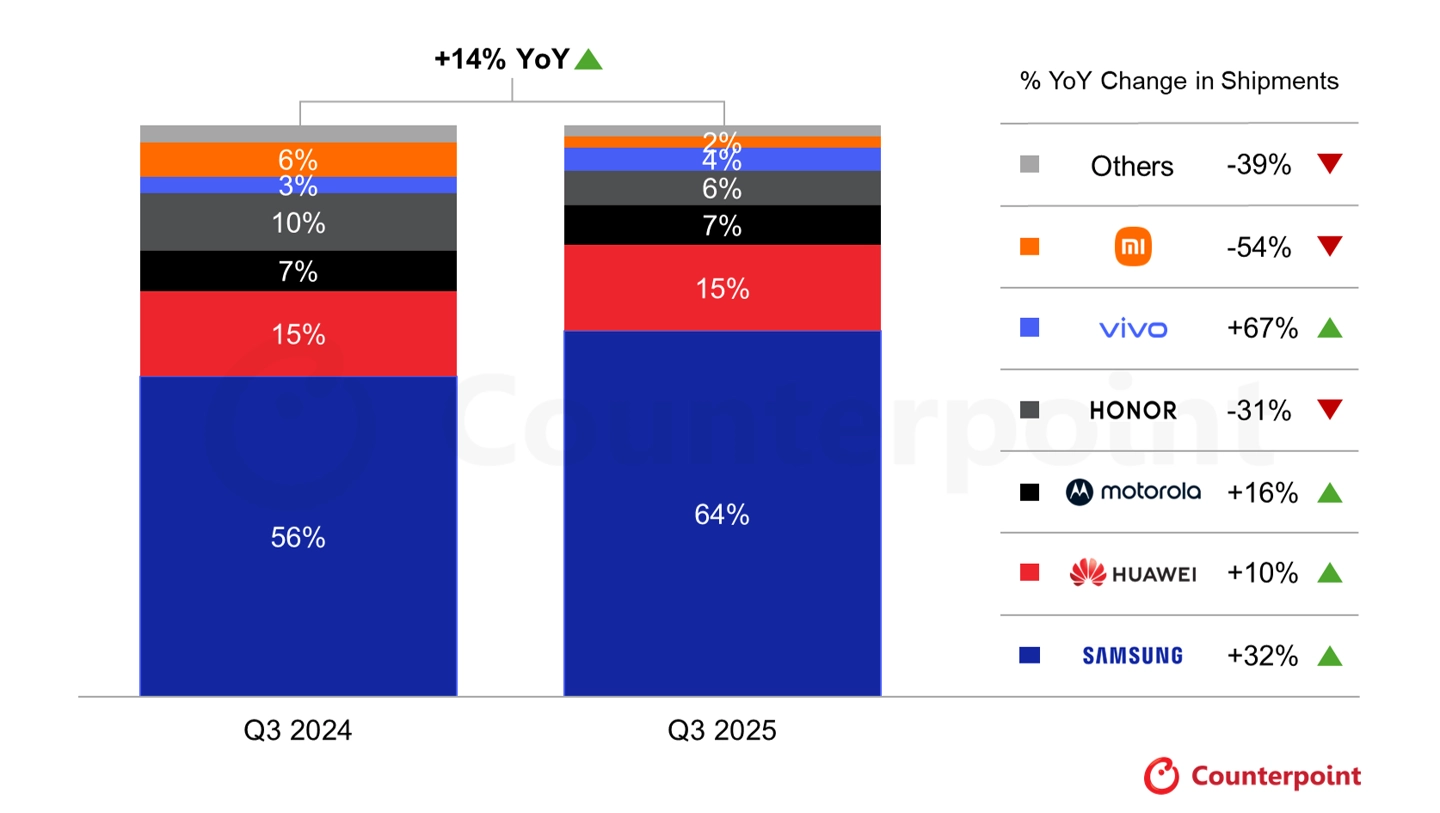
The foldable smartphone market of the world recorded a notable performance in Q3 2025, with worldwide shipments rising 14% year-on-year and reaching the highest level ever for a single quarter. According to Counterpoint Research, foldable devices now represent 2.5% of all smartphone shipments globally. Such growth was driven by strong momentum in horizontally foldable models and the release of several new flagship products. For readers interested in Xiaomi’s software ecosystem, you may explore HyperOS features on our website or review Xiaomi foldable histories through our existing archives.
Overview of Q3 2025 Market
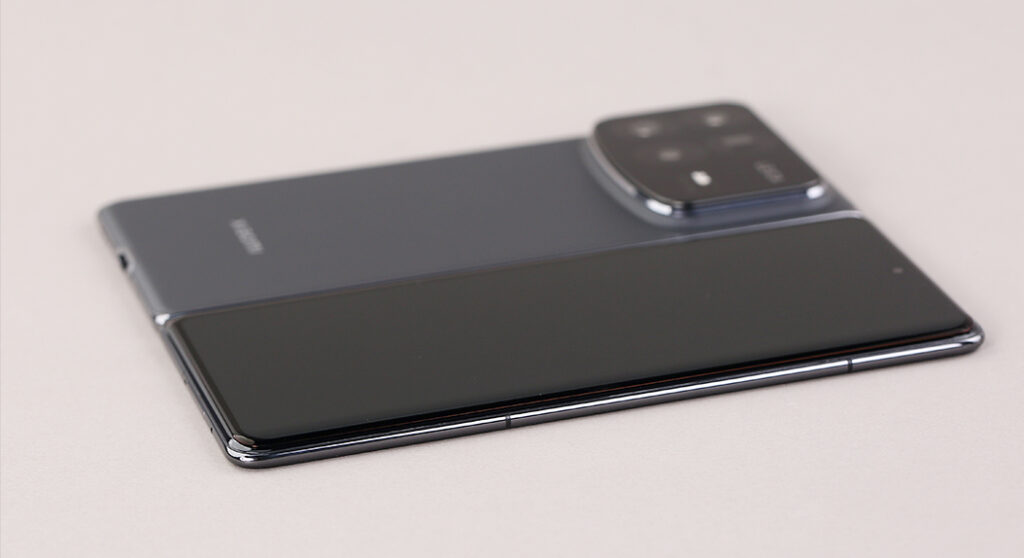
Shipments of foldable phones continued to grow steadily as demand for large-screen productivity devices increased. This reflects a broader trend in the industry where durability enhancements and more mature hinge engineering have supported consumer confidence. Meanwhile, Samsung and Huawei maintained strong positions in the market, while Xiaomi saw a noticeable contraction in this quarter’s foldable shipments. Xiaomi didn’t release their new MIX FOLD 5 this year. This is the main reason of shipments drop.
Brand Key Performance Indication
Samsung retained the lead with a 32% year-on-year increase, largely supported by the Galaxy Z Fold7. It was followed by Huawei, which posted a 10% increase due to consistent performance from its Mate foldable series. Motorola similarly managed to achieve a 16% rise, this time helped by strong demand from the Razr 60 line-up and competitive pricing.
However, Honor witnessed a decline of 31%, while Vivo managed to achieve a growth of 67%, displaying strong traction with its latest foldable models. Xiaomi posted a foldable shipment decline of 54% and reflected increased competition, shifting consumer preference within China’s premium market segment.
Market Drivers of Growth
The demand for horizontally foldable devices, favored for productivity and entertainment, remained the lead driver of market growth. Samsung’s refreshed global lineup and Motorola’s strengthened distribution channels contributed further to the uptake of vertically folding phones.
With each upgrade in thinner, lighter, and more durable constructions, foldable devices are considered serious alternatives to conventional smartphones for premium users. The manufacturers are also focusing on optimizations in hinges and panels in order to provide more refined engineering with each generation.
Emerging Trends and Future Outlook
Counterpoint Research also forecasts double-digit year-over-year growth in the foldable category through 2025. A larger growth phase should happen in 2026, driven by advances in material engineering, reducing the thickness of the devices, and more abundant AI-driven user experiences directly integrated with the foldable interface.
Apple’s entry in 2026
The most impactful development still to come will be Apple’s entry into the foldable market, expected in the second half of 2026. Using this large base of iPhone users as leverage, Apple is likely to accelerate replacement cycles for the premium segment and increase market competition. This may force existing brands, which include Xiaomi, Samsung, and Huawei, to aggressively innovate more with multi-form-factor devices.

TriFold Strategy of Samsung
Ahead of Apple’s arrival, Samsung has already taken a strategic step by releasing its limited edition Galaxy Z TriFold, its first tri-fold device. According to Counterpoint’s Liz Lee, this model was not designed mainly to increase sales but to justify the core technologies related to hinge reliability, durability frameworks, and software adaptation to multi-panel interfaces. The purpose is to get direct user input before scaling tri-fold designs commercially.
The Q3 2025 global foldable phone market is showing greater maturity and positive long-term prospects. Although Xiaomi saw a decline in shipment this quarter, an evolving landscape and innovations coming soon from across the industry could allow future models to be more successful. In a future where competition increases, users may expect to find advanced designs, improved material engineering, and AI-enhanced experiences in the upcoming generations of foldables.